

Applied Machine Learning
Who is this course for?
Since this course requires an intermediate knowledge of Python, you will spend the first part of this course learning Python for Data Analytics taught by Emeritus. This will provide you with the programming knowledge required to do the assignments and application projects that are part of the Applied Machine Learning course.
If you are looking to implement or lead a machine learning project or looking to incorporate machine learning capability in your software application, this course is appropriate for you. This is a programming course: you will be required to write code, but no prior programming knowledge is required.
PREREQUISITES:
The course requires an undergraduate knowledge of statistics (descriptive statistics, regression, sampling distributions, hypothesis testing, interval estimation etc.), calculus (derivatives), linear algebra (vectors & matrix transformation) and probability (conditional probability/Bayes theorem).
*Assessment: Students will be given an assessment to test their math skills prior to commencement of the course. You can view sample questions by clicking here. To familiarize yourself with the topics of the assessment, refer to learning resources by clicking here.
$ 200B
11.5 million
$ 132k
Course Highlights

240+ Faculty Video Lectures

45 Quizzes / Assignments

18 Moderated Discussion Boards

20+ Q&A Sessions with Course Leaders

12 Application Projects

Includes Live Online Teaching
Learning Journey
Going beyond the theory, our approach invites participants into a conversation, where learning is facilitated by live subject matter experts and enriched by practitioners in the field of machine learning:
Define a model for your data and make the model learn.
Build regression models to predict an unknown output from a given set of inputs.
Create classification models to categorize datasets such as email messages as spam or non-spam.
Develop unsupervised models like topic models or recommender systems to extract hidden patterns from large amounts of data
Determine hidden parameters in data to improve the accuracy of your model's predictions.
Create probabilistic data models to predict a range of possible outcomes that account for real-world risks and uncertainties.
Program Topics
Part 1: Python for Data Analytics (Video content and delivery by Emeritus)
Module 1: Introduction to Data Science
Learn the tools, skills, and common workflows of data scientists, identify bias in data science, and understand reproducibility, collaboration, and communication.
Module 2: Working with Data Types and Operators in Python
Learn to code in Jupyter Notebooks and use various data types in Python including strings, integers, floats, Booleans, lists, and tuples.
Module 3: Writing Functions in Python
Use functions and methods to perform analyses and identify correct syntax of functions along with uses of if statements and loops.
Module 4: Popular Data Science Packages in Python
Perform basic analyses and define proper syntax using NumPy and Pandas, import and use packages in Jupyter Notebooks, and filter and slice data frames with Pandas.
Module 5: Advanced Functions
Analyze data frames with lambda functions and construct complex functions with multiple parameters, nested functions, as well as functions with default arguments;
Module 6: Data Manipulation and Analysis with Pandas
Use Pandas to build, extract, filter, and transform data frames as well as to manipulate and transform a dataset from Kaggle.
Module 7: Data Visualization with Matplotlib
Draw insights from your data and communicate recommendations to others by creating data visualizations such as basic plots, source codes, and time series using Matplotlib.
Module 8: Random Variables and Statistical Inferences
Examine probability as well as statistics in Python, differentiate between standard deviation and variance in a dataset, and collaborate on GitHub.
Module 9: Statistical Distributions and Hypothesis Testing
Use normal distribution, t-distribution, and Bernoulli distribution in Python, test a model using P values as well as confidence intervals, and conduct basic hypothesis testing.
Module 10: Data Cleaning
Examine and clean different types of data across data types to prepare it for analysis and place data into a Tidy Data format.
Module 11: Exploratory Data Analysis
Learn new methods to explore and visualize your data with Matplotlib, define key characteristics of exploratory data analysis methods, and use them to describe data.
Module 12: Getting Started with Linear Algebra for Machine Learning
Apply foundational linear algebra concepts in Python to build basic algorithms, solve equations with matrix operations, and perform advanced linear algebra procedures.
Part 2: Applied Machine Learning (Video content from Columbia Engineering and delivery by Emeritus)
Supervised Learning
Module 1: Regression
Perform supervised learning with probabilistic models, linear regression, and maximum likelihood, use matrix operations to code least squares, and implement Ordinary Least Squares.
Module 2: Ridge Regression
Analyze the bias-variance tradeoff through least squares and ridge regression, apply the Bayes rule to quantify uncertainty, and use regression analysis to solve a real-world problem.
Module 3: Bayesian Methods
Understand “active learning,” the Lagrange multipliers tool, and the sparse regression model, identify MAP solutions, estimate covariants, and apply Bayesian linear regression.
Module 4: Classification Algorithms
Deal with classification using nearest neighbors, K-nearest neighbors, and the Bayes classifier, predict outcomes with supervised learning classification, and use the perceptron algorithm.
Module 5: Logistic Regression, Kernel Methods, and Gaussian Processes
Analyze logistic regression and its algorithm, learn about a kernel, kernelized perceptron, the Nadaraya-Watson regression model, and Gaussian processes.
Module 6: Support Vector Machines and Decision Trees
Plot hyperplanes with the maximum margin method, modify SVM, code decision tree-based classifiers to make predictions about variables, and organize grid search hyperparameters.
Module 7: Boosting and K-Means Clustering
Understand a bootstrap dataset and decision stump, learn about bagging and boosting techniques, identify characteristics of K-means tools, and use a label encoder.
Unsupervised Learning
Module 8: Clustering Methods
Code functions in Python implementing K-means, soft K-means, and Gaussian mixture model clustering to assign points and recalculate clusters.
Module 9: Recommendation Systems
Employ recommendation systems to predict a user score, compare LDA vs. PMF vs. NMF, translate a mathematical algorithm into code, and use SVD to make item recommendations.
Module 10: Principal Component Analysis and Markov Models
Use PCA to code a recommender system in Python, implement PCA using sklearn, prepare and scale data in preparation for PCA, and implement Markov chains using quantecon.
Module 11: Hidden Markov Models and Kalman Filtering
Make predictions about variables using the Hidden Markov Model, differentiate between PCAs, Markov models, and Gaussian models, and use forward/backward algorithm to solve HMM.
Module 12: Association Analysis and Model Selection
Apply association analysis to a dataset, model future stock prices using sequential methods, apply one-hot encoding to a data frame, and use the library Mlxtend for association analysis.
Application Projects

Movie Recommendation Engine
You will build a movie recommendation engine by applying collaborative filtering and topic modelling techniques. You use a dataset which contains 20 million viewer ratings of 27,000 movies.

House Price Prediction
You will write code to predict house prices based on several parameters available in the Ames City dataset compiled by Dean De Cock using least squares linear regression and Bayesian linear regression.

Human Activity Prediction
You will predict the human activity (walking, sitting, standing) that corresponds to the accelerometer and gyroscope measurements by applying the nearest neighbours technique.

Credit Card Fraud Detection
You will detect potential frauds using credit card transaction data. You will apply the random forest method to identify fraudulent transactions.

Marketing Segmentation
You will create market segments using the US Census dataset and by applying the k-means clustering method.
Note: All product and company names are trademarks™ or registered® trademarks of their respective holders. Use of them does not imply any affiliation with or endorsement by them.
Faculty

DR. JOHN W. PAISLEY
Columbia University Associate Professor, Electrical Engineering Affiliated Member, Data Sciences Institute
John has a PhD from Duke and has been a postdoctoral researcher in the Computer Science departments at Princeton University and UC Berkeley. John Paisley’s research focuses on...
Testimonials
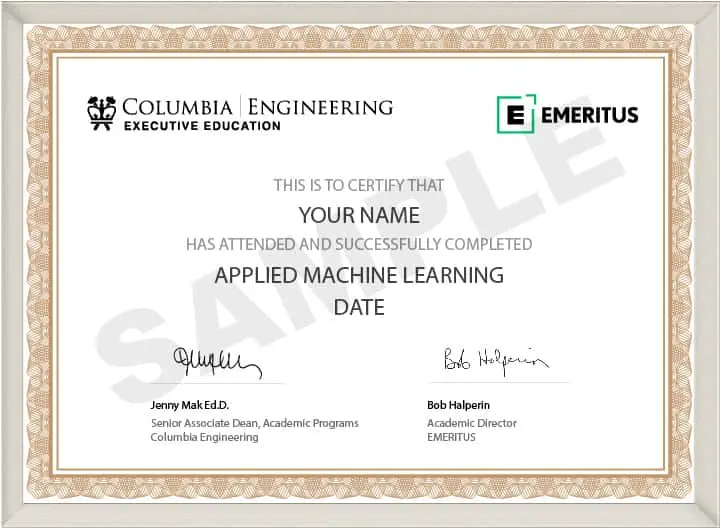
Certificate
Upon successful completion of the course, participants will receive a verified digital certificate from Emeritus in collaboration with Columbia Engineering Executive Education.
Course FAQs
What is the process to enroll for the course?
Review the sample math assessment, to see if you feel confident with the material that includes Calculus, Linear Algebra, Statistics, and Probability.
Review the learning resources to familiarize yourself with the assessment quiz content.
Submit your application.
Take the math assessment. You will have two attempts. Participants who pass the assessment will receive access to the course. Any deposit fees will be refunded to participants who do not pass the assessment.
Why should a Statistician/Mathematician enroll in this course?
The course familiarizes you with Machine learning algorithms and applications. It will also help you understand the approach to a business problem and provide you with the tool knowledge needed to transition to a Machine Learning or a Data Science role.
Why should a Data Scientist/Data Engineer/Big Data Engineer enroll in this course?
The course familiarizes you with Machine learning algorithms and applications and provides a solid foundation in statistics/mathematics and problem-solving skills to help you solve enterprise-level problems. The Applied Machine Learning course augments your existing knowledge of various tools and expands your skill set as a Data Science or Machine Learning professional.
Why should a Software Developer enroll in this course?
The course familiarizes you with Machine learning algorithms and applications while providing a solid foundation in statistics/mathematics and enhancing your business acumen. It augments your existing programming knowledge and expands the technologies you are familiar with, helping you further develop your skill set as a Data Science or Machine Learning professional.
My current role in my company does not include exposure to Machine Learning. Does it make sense for me to enroll in this course?
Absolutely! Knowledge of Data Science and Machine Learning (ML) has quickly become a requisite across industries, and all businesses will eventually need to use these techniques to thrive. While your current role may not require Machine learning knowledge, it is almost certain that ML skills will be in high demand in most every industry in the future.
How can I implement the concepts and ideas discussed in the course?
The course is a blend of theory, tools, and case studies (datasets) that are easy to assimilate and implement. For instance, students work on application projects that require them to apply the Machine Learning concepts they’ve learned to datasets and derive inferences. These application projects are intentionally made to be challenging, and students are expected to spend substantial time and effort solving them. At the end of the course, students will be able to apply Machine Learning to solve many of the business problems they face in their workplace.
What is the relationship between Emeritus and Columbia Engineering Executive Education?
Columbia Engineering Executive Education is collaborating with online education provider Emeritus to offer a portfolio of high-impact online courses. These courses leverage Columbia’s thought leadership in management practice developed over years of research, teaching, and practice.
What software and versions will I need in this course?
Recommended System Requirements
Processors: 2.60 GHz
RAM: 8 GB of RAM
Disk space: 2 to 3 GB
Operating systems: Windows 10, MacOS and Linux
Python download link
Compatible tools: Any text editor, Command prompt
Minimum System Requirements
Processors: 1 GHz
RAM: 1 GB of RAM
Disk space: 1 GB
Operating systems: Windows 7 or later, MacOS and Linux
Python versions: 2.7.X, 3.6.X
Compatible tools: Any text editor, Command prompt
What is the program refund and deferral policy?
For the program refund and deferral policy, please click the link here.
Who will be collecting the payment for the program?
Emeritus collects all program payments, provides learner enrollment and program support, and manages learning platform services.
Are there any restrictions on the types of funding that can be used to pay for the program?
Program fees for Emeritus programs with Columbia Engineering Executive Education may not be paid for with (a) funds from the GI Bill, the Post-9/11 Educational Assistance Act of 2008, or similar types of military education funding benefits or (b) Title IV financial aid funds.
How does Emeritus support accessibility for learners?
Emeritus is committed to making high-quality education accessible and affordable to individuals, companies, and governments around the world. If you have questions about accessibility or would like to discuss available support options before enrolling, please contact accessibility@emeritus.org. For more information about our accessibility practices, please review our Accessibility Policy here.
Didn't find what you were looking for? Write to us at learner.success@emeritus.org or Schedule a call with one of our Program Advisors or call us at +1 315 840 3227 (US) / +44 203 838 0797 (UK) / +65 3129 4176 (SG)
Flexible payment options available.
Starts On